
Automatic WhatsApp replies, around the clock
Most of what reaches you repeats: shipping, sizes, availability, payment methods. Answering it does not need an employee awake at 3am — it needs an answer written once.
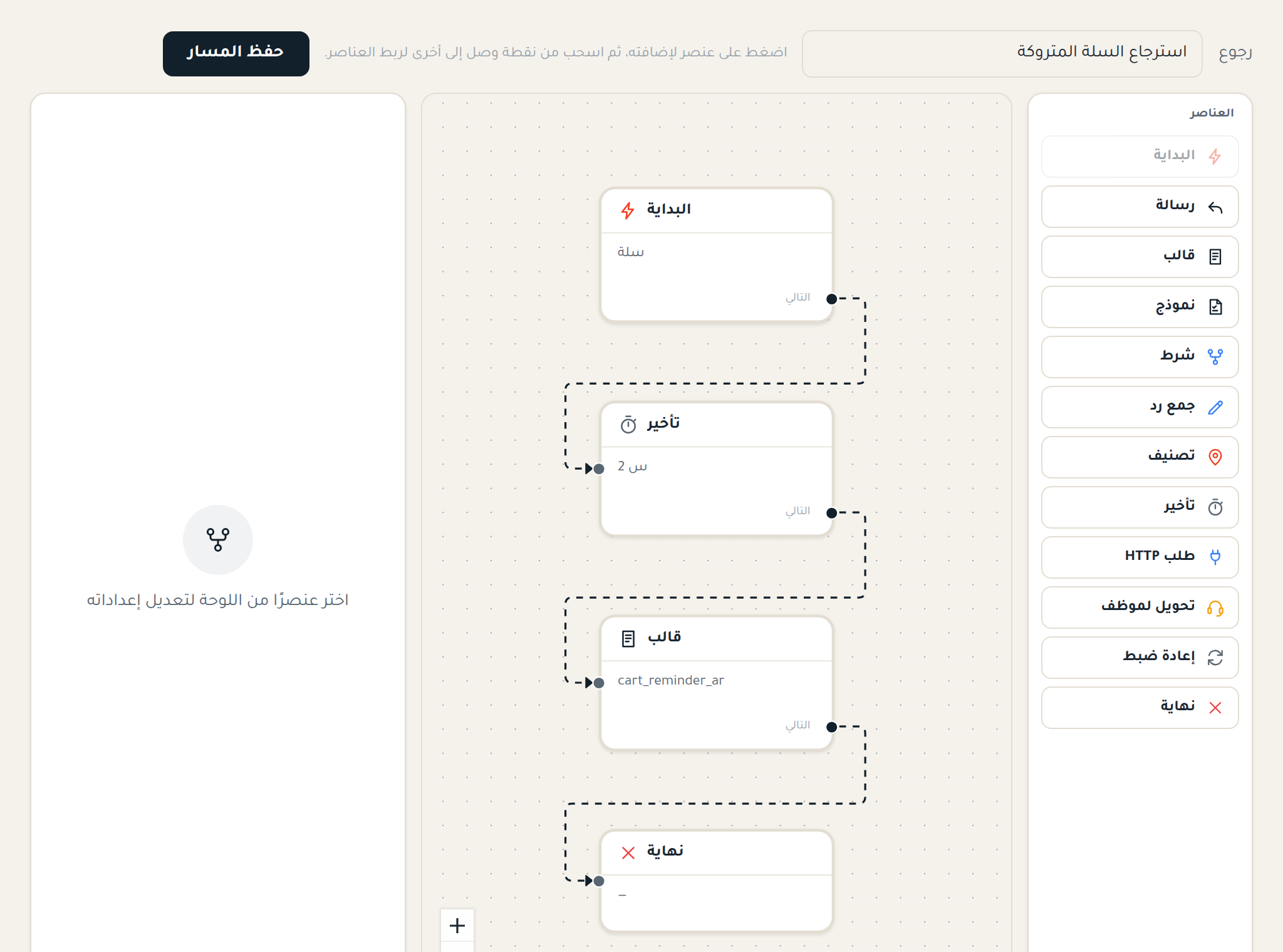
Flows you build yourself
The conversation is built by dragging: a question, options, a condition, then a reply or a handover. No code, and in Arabic.
An AI assistant grounded in your data
The assistant answers from the business information you enter and the knowledge base you approve — not from general knowledge. An invented answer about your return policy is worse than no answer.
And when automation should stop
When a customer asks for a person, or the question leaves what is known, the conversation moves to the inbox and is assigned to an agent. Automation that does not know when to step aside loses the customer.
What deserves an automated reply and what does not
An automated reply works when the question repeats and the answer is fixed, and fails when the question is a special case.
Shipping, sizes, payment methods, opening hours, location — the answers don't change, and the customer wants them now, not tomorrow.
But "my order arrived damaged" or "I want a refund" are not questions, they are situations, and an automated reply to them adds anger. The rule: automate the information, not the decision.
When the automation stops — which matters more than when it starts
The worst possible experience is an automated reply continuing while a human is handling the same conversation. In Barqia the AI assistant goes quiet for six hours after an agent SENDS a message in the chat — sending is the signal, not opening the conversation or typing in it. So the handover to a human starts at the first human reply, and lapses automatically six hours later if nobody replies again.
If your conversations run longer than that, close them when they are done rather than leaving them open — and assign them, so it stays clear who is handling what.
The reply also stops when the customer explicitly asks for a person. That request is not a failure of the automation but a success: it got the case to someone who can resolve it.
Always make the exit obvious. A customer who feels trapped in a menu calls you angry, or leaves.
The AI assistant: on your data, not the internet's
The assistant answers from your business profile, your products and your knowledge base — not from the internet. That is what stops it inventing a return policy you do not have.
The knowledge base is where approved answers are written once: shipping, returns, warranty. The assistant uses them, and so do your staff — so the customer gets the same answer whether a machine or a person replied, and that consistency is half the value.
Usage is metered per conversation rather than per message — a conversation with ten messages counts once, which is what makes the cost estimable at all. (Your consumed conversation count is not shown in your dashboard today; you see your plan's allowance rather than your usage.)
Automation is not an answer to everything
Read your conversations for a month before you build a flow. The flows that fail most were built on what the merchant assumed customers ask, not on what they actually ask.
Start small: three questions answered well beats twenty answered adequately. Then expand from what you see in message search — which words keep coming up?
Outside working hours: the case that matters most
What a store loses most is not the hard question but the simple one at eleven at night. The customer is awake, intends to buy, and is asking about shipping — and falls asleep before anyone replies, and wakes up having bought elsewhere.
Automation here does not replace an employee, because there is no employee at that hour. It does two things: answers if the question is a known one, and honestly says when humans return if it is not.
The second is worth as much as the first. "We reply from nine in the morning" is an answer that keeps the customer; silence is also an answer, and it means you are not there.
Automation as marketing, not only service
Every service conversation is a marketing signal, if it is recorded. Someone asking about a size is interested in a specific product; someone asking about shipping to their city is close to buying; someone complaining twice is at risk of leaving.
Those are signals you can target on later: a campaign for people who asked about a product and did not buy, or an apology and an offer for someone who rated the service poorly.
That is the difference between a support tool and a growth tool. The first closes the conversation; the second remembers it.
How to start
- 1Activate your WhatsApp Business number through Meta's embedded signup.
- 2Read a month of conversations and pull out the five most repeated questions.
- 3Write their answers into the knowledge base — once, used by both the assistant and your team.
- 4Build a flow for the simplest of them, and leave the rest to the assistant or a person.
- 5Make "talk to a person" a visible option at every step.
- 6Review after two weeks: which question still reaches a human? That is your next flow.
Common questions
- Does it understand Saudi dialect?
- The assistant works in Arabic including colloquial phrasing; its accuracy still depends on how clearly you have given it the information.
- Does it only reply outside working hours?
- You decide: always on, outside hours only, or for specific questions only.
- What if the assistant gets it wrong?
- You review conversations in the inbox and correct the knowledge source, and you can restrict the assistant to topics you have approved.
- Is there a limit on AI usage?
- Yes, according to your plan, and the usage is visible to you in the dashboard.
- Can the automation reply to a marketing message I sent?
- When a customer replies to your campaign, a 24-hour service window opens and the automation can answer inside it in free text. This is one of the most wasted moments in retail: a campaign goes out and nobody answers the people who answered it.
- What if the assistant does not know the answer?
- It says it does not know and hands off to a person — which is the behaviour you want. An assistant that invents a confident answer is worse than one that stays quiet, because the customer believes it and then finds out.
- Can the automation send a product or an image?
- Yes. Inside the service window (24 hours after the customer writes) you can send images, files and products from the catalog synced from Salla or Zid — so the customer sees the price and the picture without leaving the conversation.
- Do automated replies count against my message quota?
- Replies inside the service window are a different thing from template messages you initiate. AI assistant usage is metered per conversation rather than per message, and counts against your plan's allowance. (Showing how much of it you have consumed, in your own dashboard, is not available yet.)