
Abandoned cart recovery over WhatsApp
An abandoned cart is not a customer you lost — it is a customer who reached the last step and stopped. Confirmed interest, a cart already built, and a number you have. One WhatsApp reminder brings some of them back; a three-touch sequence brings more, provided it stops the moment they buy.
Why WhatsApp specifically
A cart-recovery message is either read or it is not — and that is the whole difference. Email in the Gulf market lands in an inbox few people open, and SMS carries no image, no button, and no conversation to continue in.
WhatsApp carries all three: the product image, a link that opens the cart exactly as the customer left it, and a channel they can reply to immediately with a question — and most people who hesitate hesitate over something small and answerable: is shipping free? when does it arrive? can I pay on delivery?
So half the value of a cart message is not in the message; it is that a reply finds a human behind it.
Timing: three touches, and why
The first touch after an hour or two. Early enough that the customer remembers what they were doing, late enough not to feel like you are watching their screen.
The second after a day. Many carts are abandoned because the moment was wrong — in the car, at work, before bed — not because the answer was no, and tomorrow is a different moment.
The third after three days, and it is the last call, so write it as one. Then stop: a week-old cart is not a warm lead, and Barqia gives up automatically at seven days.
Each delay is measured from when the cart was left, not from the previous reminder — so one quiet-hours deferral cannot push the rest of the sequence into next week.
What stops the sequence
The real risk in a three-message sequence is chasing a customer who already bought. In Barqia, the first order that arrives from your store immediately closes every open cart for that customer, so nobody gets a message about a cart they paid for yesterday.
The sequence also stops if the customer opted out of marketing, pauses if the moment falls inside quiet hours (deferred, not cancelled), and holds if that number has already received enough messages today.
That last check deserves a pause: one customer may have more than one cart, and their reminders may cross a campaign. The per-number cap is what stops two marketing messages arriving within an hour. It does not cover utility messages — an order confirmation and a shipping update go out when they happen, so allow for them when you choose your reminder timing.
What to write in the three messages
Do not send the same text three times. In practice you cannot: each message needs its own Meta-approved template, and that constraint is on your side.
- First — a neutral reminder: "you left this in your cart; the link brings it back exactly as it was".
- Second — remove an obstacle: mention shipping, cash on delivery, or the return policy. Most hesitation is an unanswered question.
- Third — an explicit last call, and it can carry an incentive if you decide so. Don't lead with the incentive in the first message, or you teach your customers to abandon carts deliberately.
Measuring the result honestly
The easiest number to fool yourself with is "recovered revenue". If you count every order that arrives after a message as caused by the message, you are crediting yourself with purchases that were going to happen anyway.
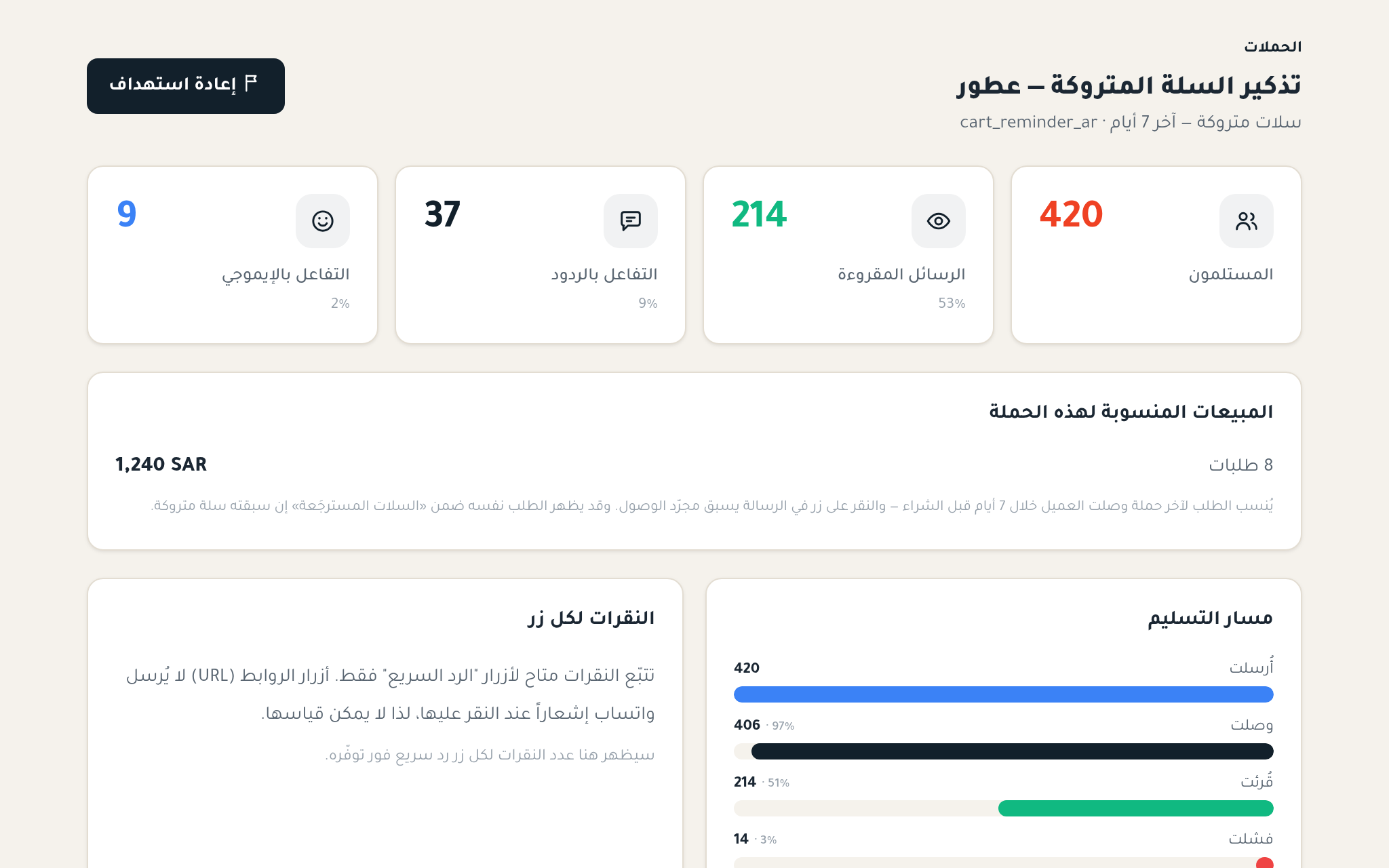
Barqia separates the two: how many carts closed with a purchase at all, and how many of those had actually received a reminder. The second is the one that belongs to you, and it is what the ROI panel shows.
A reminder is counted only after Meta accepts it — not when sending was attempted. An attempt that was rejected or held by a frequency cap is not a delivered message, and counting it as one makes every ratio after it a small lie.
Who abandons, and why
Before you write a message, know who you are writing to. The common reasons are few and most are fixable in one message.
Shipping cost that appeared at the last step. Their preferred payment method missing. Hesitation over a size or a spec. A price comparison with another store. Or simply: the moment broke — the phone rang, the lift arrived, the child woke.
That last one is the largest, and it is what makes reminding worthwhile at all: not a negative decision to reverse, but an interrupted intent to resume. The other four need a message that answers rather than one that insists — which is why the second touch is "remove an obstacle" and not "remind again".
How to start
- 1Connect your Salla or Zid store — that is where the cart events and the resume link come from.
- 2Activate your WhatsApp Business number through Meta's embedded signup.
- 3Get a template approved for each reminder you intend to send — at least one, three for the full sequence.
- 4Set the timing: two hours, then a day, then three days — or whatever matches your purchase cycle.
- 5Send a test to your own number first, so you see the message as the customer will before anyone else does.
- 6Check the ROI panel after two weeks and compare reminded carts against the rest.
Common questions
- Is this allowed on WhatsApp?
- Yes, within Meta's rules: the reminder is sent on an approved template, to someone who left their details in your store, and with a way to opt out.
- Does it work with Salla and Zid?
- Yes — Salla and Zid connect directly, and abandoned carts arrive automatically with no file uploads.
- How many reminders should I send?
- That is your call and the platform lets you set it. The real answer shows up in your own reports, because every store and market differs — which is why we will not quote you a number.
- Can I exclude some customers?
- Yes — and anyone who opts out is automatically excluded from every later campaign and reminder.
- Can the customer buy from inside the message?
- The message carries a link that opens their cart in your store exactly as they left it — same items, same quantities — so the purchase completes in your store, not inside WhatsApp. That is simpler for the customer and cleaner for you: the order lands in the store with your normal payment and shipping flow.
- What if a customer leaves more than one cart?
- The per-number frequency cap sits above everything, so a customer does not get one reminder per cart in the same day. And on their first purchase, all their open carts close at once.